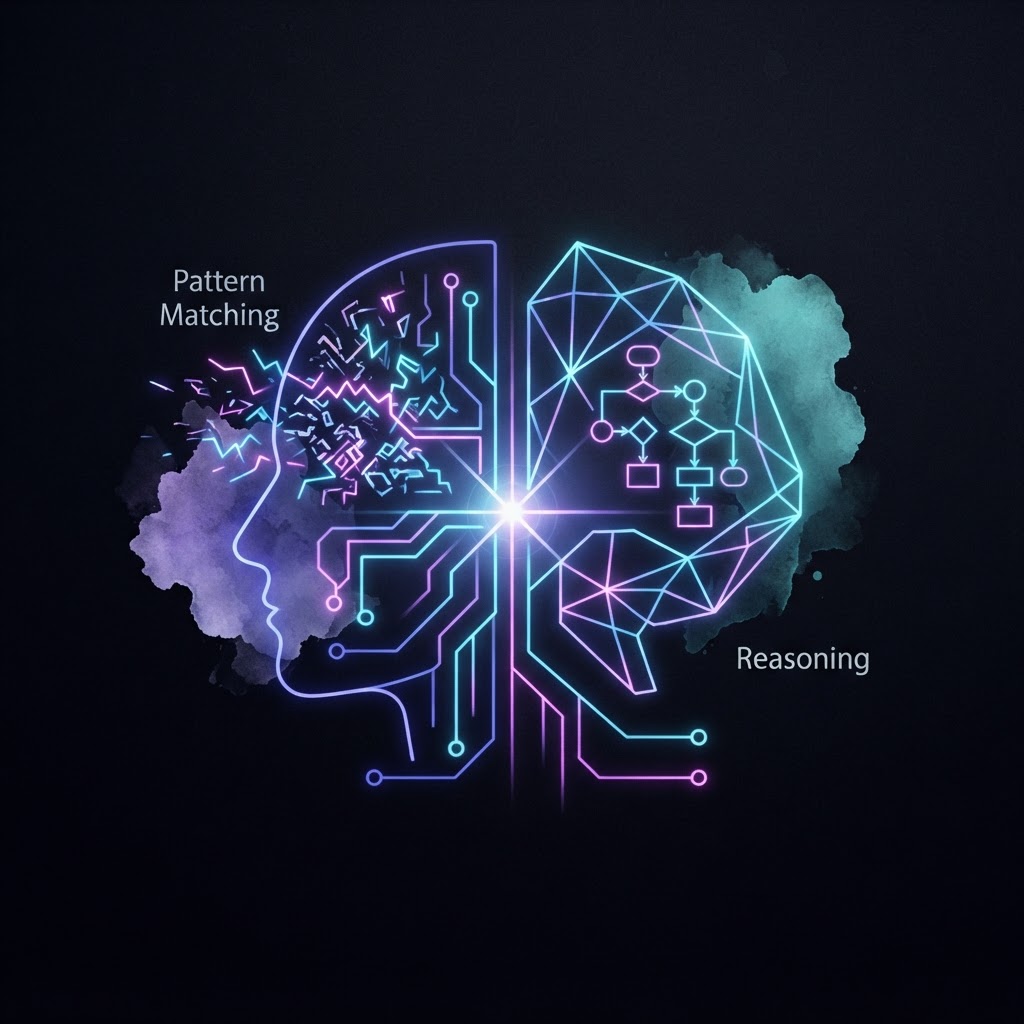
The Thinking Machine: Why Reasoning Beats Pattern Matching
The pause is the product
We have spent years training ourselves to expect immediate gratification from our software. You type a prompt, you get a response, and you move on. This is the rhythm of the pattern matcher. It is fast, it is confident, and it is often wrong when the stakes are high.
OpenAI's o1 series changes the fundamental contract between user and machine. By introducing a deliberate pause for chain of thought reasoning, the model is not just predicting the next token. It is checking its own work. It is exploring a decision tree before it commits to a path.
The shift from speed to accuracy
Most of your current AI stack is optimized for latency. You want the text to appear as fast as you can read it. But in high-stakes environments like software architecture, scientific research, or complex financial modeling, speed is a vanity metric. Accuracy is the only currency that matters.
- Pattern matching models are great for creative drafting and basic summarization.
- Reasoning models are built for structural problem solving and logical verification.
- The cost of a wrong answer in a complex system is orders of magnitude higher than the cost of waiting five seconds for a correct one.
The new operational reality
If you are a leader, you need to stop treating all AI interactions as equal. You are now managing two distinct types of cognitive labor. You have the fast, intuitive engine for daily communication and the slow, deliberative engine for strategic execution.
Do not force your team to use a reasoning model for a simple email draft. You are burning compute and time for no gain. Conversely, do not trust a standard model to architect your next database migration. You are inviting failure by prioritizing speed over rigor.
What this means for leaders
Your job is to map the right cognitive profile to the right task. Stop looking for a single model to rule them all. Start building workflows that distinguish between tasks requiring intuition and tasks requiring deep, verifiable logic.
If your team is still treating every AI interaction as a chat, you are missing the point. You are paying for a Ferrari and using it to drive to the mailbox. Start auditing your AI usage today. Identify the high-stakes decisions where a pause for reasoning would save you from a costly mistake. Then, move those tasks to the reasoning engine.
The Enterprise & Public Sector AI Integration Playbook
No spam. One email with the asset, then occasional Spark updates.