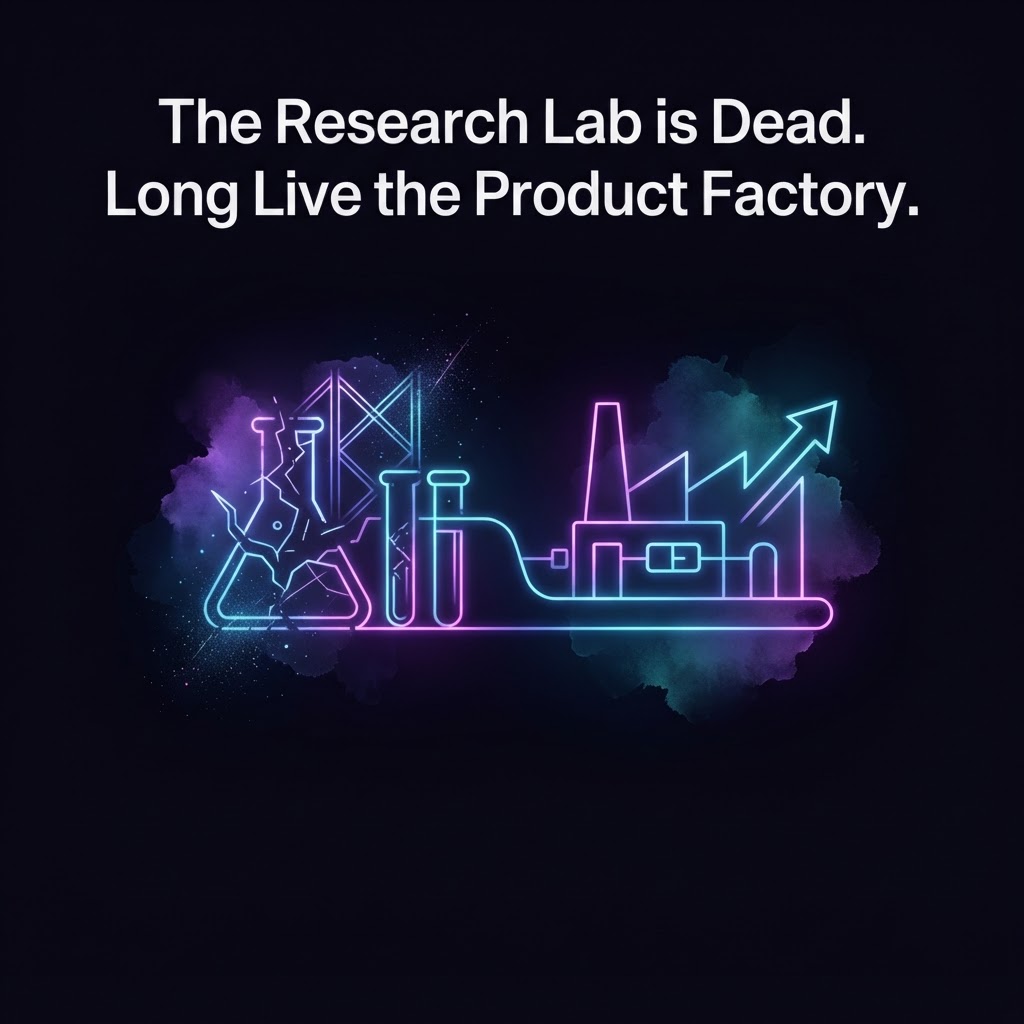
The Research Lab Is Now A Product Factory
Demis Hassabis is moving to the attic. Google DeepMind, the crown jewel of AI research, just signaled that the era of the philosopher-king is over. By stepping down as CEO to become Chairman and Chief Scientist, Hassabis is effectively being moved out of the way of daily operations.
Sundar Pichai does not need more Nobel Prizes. He needs a product that stops hallucinating and starts making money. This move is the most significant leadership shift in the AI sector this year.
It marks the transition from big tech supporting pure research to a focus on commercial utility. For a decade, DeepMind was the expensive hobby that Google kept in the basement to look smart. Now, the basement is the engine room, and the engineers are taking over from the scientists.
The Productization Mandate
When you are burning billions of dollars on compute, curiosity is a luxury you can no longer afford. The restructuring at Google DeepMind is a blunt admission that the organizational structure required to win a Go match is not the same structure required to win the enterprise software market. Research labs are built for breakthroughs.
Product factories are built for reliability, margins, and distribution. Hassabis is a visionary. He wants to solve intelligence to solve everything else.
But Google has a more immediate problem: Microsoft and OpenAI are eating their lunch in the cloud. The shift in leadership suggests that Alphabet is tired of waiting for AGI to emerge from a petri dish. They want features.
They want APIs. They want Gemini to actually work across the Google Workspace without needing a human to babysit the output.
The Chairman Trap
In the corporate world, the title of Chairman is often a polite way of saying: thank you for your service, now please stop attending the operational meetings. By moving Hassabis to a Chief Scientist role, Google is trying to preserve the brand of his genius while removing the friction he might cause in a high-velocity product environment. Scientists care about the truth.
Product managers care about the release date. When those two worlds collide, the release date usually wins. Google can no longer afford to prioritize research over results.
The competition is moving too fast, and the capital expenditures are too high to justify anything less than total market dominance.
The New AI Leadership Profile
We are seeing a new archetype of AI leader emerge. It is no longer the academic with a PhD from Stanford or Cambridge. It is the operator who understands how to bridge the gap between a stochastic parrot and a predictable business process. The new guard at DeepMind will likely be judged on different metrics:
- Latency over Latent Space: How fast can the model respond to a user query?
- Inference Costs: Can we run this model without bankrupting the company?
- Integration Depth: How well does the AI play with legacy databases and third-party tools?
- Safety as a Feature: Not just ethical safety, but operational safety that prevents brand-damaging errors.
What this means for leaders
If you are leading a team or a company, you need to stop treating AI as a science project. The transition at the top of Google is your signal to do the same. You do not need a research department. You need an implementation department.
- Stop chasing the frontier. Most businesses do not need the most powerful model in the world. They need the most reliable model for their specific use case. A smaller, cheaper model that works 99 percent of the time is better than a frontier model that works 80 percent of the time.
- Hire operators, not just data scientists. You need people who understand how to build software, not just people who understand how to train weights. The value is moving from the model itself to the orchestration layer around it.
- Focus on the workflow, not the chat box. The era of the chatbot is already peaking. The future is agentic systems that live inside your existing tools. If your AI strategy requires a user to open a new tab, you have already lost.
- Measure what matters. If your AI initiatives are not moving the needle on your core KPIs, they are a distraction. Do not get blinded by the hype of a new model release. Ask how it lowers your cost of acquisition or increases your customer lifetime value. The ivory tower has been repurposed. It is time to get to work in the factory.
The Enterprise & Public Sector AI Integration Playbook
No spam. One email with the asset, then occasional Spark updates.