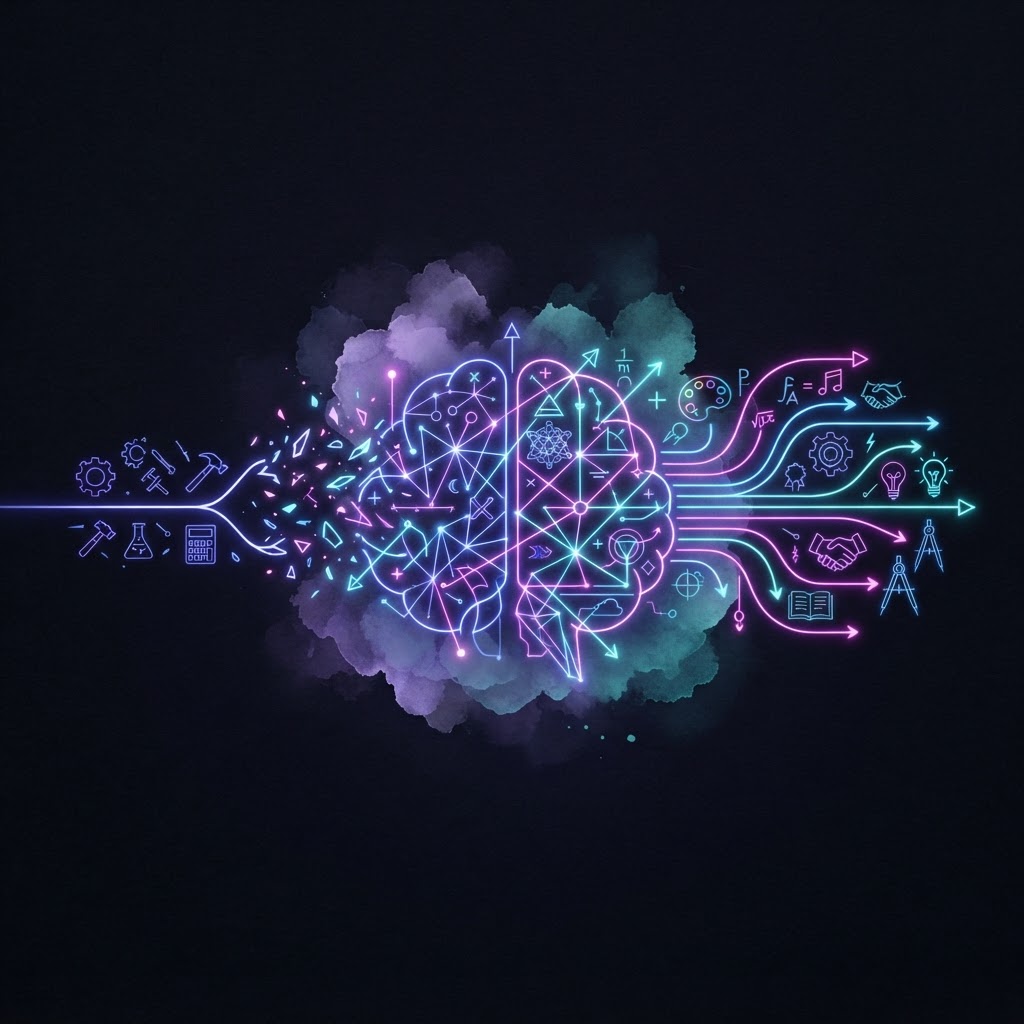
The Obsolescence of the Specialist: Why Polymaths Own the Future
Specialization is for insects. Robert Heinlein said it, and he was right. If you have spent the last decade digging a hole in one specific niche, I have bad news.
AI just filled that hole with concrete. The era of the narrow expert is complete. The next trillion dollar company will not be built by a team of five hundred hyper-specialized cogs.
It will be built by one person who understands code, psychology, supply chains, and art. It will be built by a polymath.
The Specialist Trap
We were told to pick a lane. We were told that if you want to be successful, you need to be the best at one thing. That was great advice in 1995. In 2026, it is a career limiting move. Specialists are easy to replace because their work is predictable. If your job can be defined by a narrow set of rules, a large language model can do it faster, cheaper, and without complaining about the office coffee.
When you specialize, you build a silo. You see the world through a straw. A marketing specialist sees a marketing problem. A supply chain specialist sees a logistics problem. But the real world does not care about your departments. The real world is a messy, interconnected web of problems that do not fit into neat little boxes. If you only have one tool, you are useless when the problem changes shape.
The Polymath Advantage
Polymaths do not just know things. They connect things. They are the connective tissue of a company. While the specialist is busy perfecting a single process, the polymath is looking at how that process affects the customer experience, the bottom line, and the company culture. They are the ones who see the opportunities that others miss because they are looking at the whole map, not just one square.
Connecting the Dots
Innovation happens at the edges. It happens when you take an idea from biology and apply it to finance. It happens when you take a design principle from architecture and use it to build a software interface. Specialists cannot do this because they do not know what is happening in the other rooms. Polymaths are the ones who walk through the doors and bring the best ideas with them.
The AI Multiplier
AI is the great equalizer for the polymath. In the past, you needed a team of specialists because one person could not possibly do everything. Now, one person with a broad understanding of multiple fields can use AI to execute the narrow tasks.
You do not need a junior coder, a copywriter, and a data analyst. You need one polymath who knows how to direct the AI to do all three. This makes the polymath a one-person army.
- Curiosity: The engine of the polymath. You have to want to know how things work, even if they are not in your job description.
- Synthesis: The ability to combine two unrelated ideas to create something new. This is the core of innovation.
- Adaptability: The skill of remaining relevant when the market shifts. If your niche disappears, you just move to the next one.
What this means for leaders
If you are leading a company, stop hiring for narrow skills. You can buy narrow skills by the hour from a dozen different platforms. Hire for curiosity. Hire for the ability to learn. Hire the person who has a weird hobby, a side hustle, and a degree in something totally unrelated to their current job. Those are the people who will save you when the world changes again.
You need to become a polymath yourself. Stop hiding in your office and start learning how the other parts of your business work. Talk to the engineers. Talk to the sales team. Read a book about something you know nothing about. The more dots you have, the better your picture of the future will be. The specialists are waiting for instructions. The polymaths are the ones giving them.
The Enterprise & Public Sector AI Integration Playbook
No spam. One email with the asset, then occasional Spark updates.