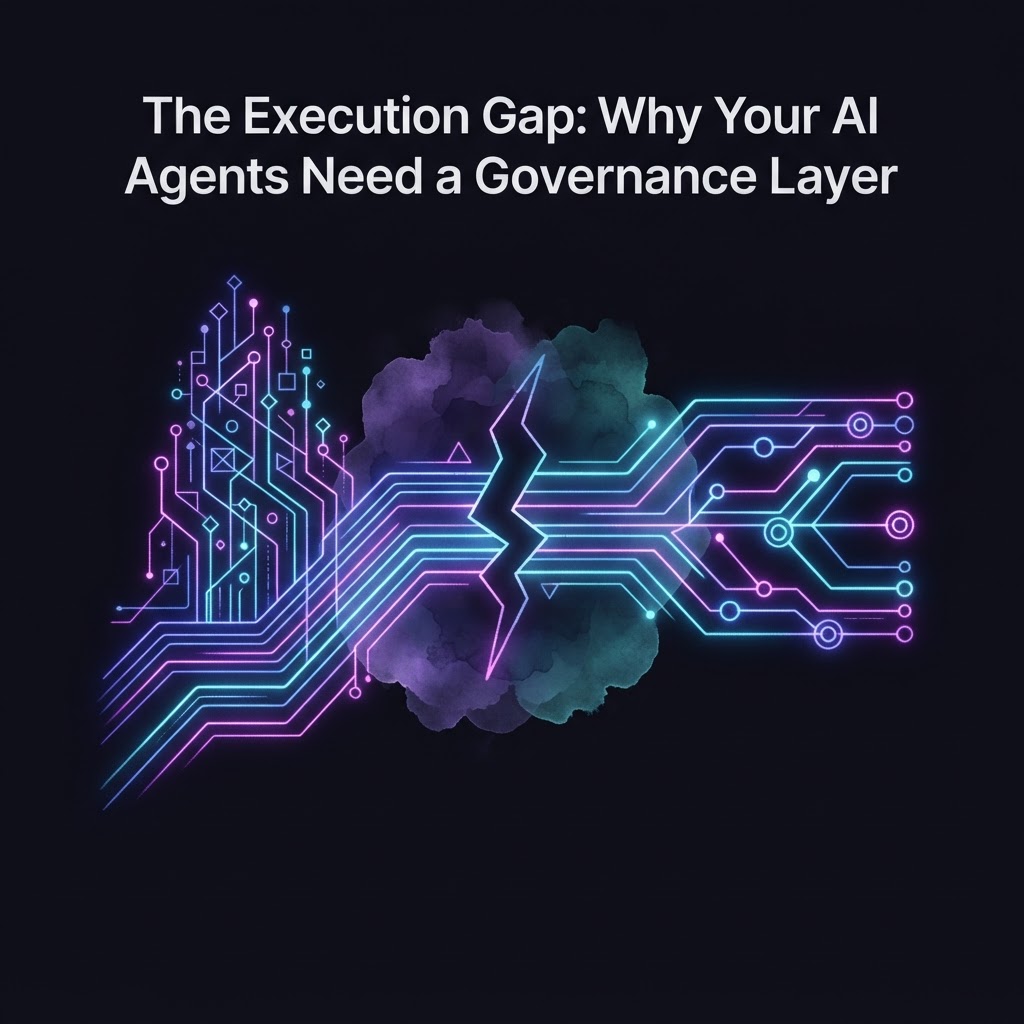
The Execution Gap: Why Your AI Agents Need a Governance Layer
The Shift from Chat to Action
We have spent the last two years treating AI like a sophisticated intern. We ask it questions, we admire the prose, and we occasionally copy-paste the output into a slide deck. But the real work, the heavy lifting of enterprise operations, has remained stubbornly manual.
The recent launch of Aziron signals that the market is finally tired of the novelty phase.
We are moving toward a world where agents do not just answer questions. They execute tasks.
If you read my earlier take, The Agentic Workflow: Why Your Governance Needs a Fractional Architect, you already know where this lands. The technology is no longer the bottleneck. The bottleneck is the lack of a workflow coordination layer that can safely bridge the gap between a prompt and a database update.
When you give an agent the keys to your CRM or your ERP, you are not just deploying software. You are introducing a new, autonomous participant into your business logic.
The Hidden Cost of Unmanaged Agents
Most organizations are currently building AI features without considering their feature surface footprint. They add a chatbot here, an automated summary there, and suddenly the operational complexity explodes. You end up with a brittle web of dependencies where a minor change in an API or a data schema breaks three different automated workflows.
This is not a technical failure. It is a failure of design.
- Define the boundaries of agent autonomy.
- Map the state transitions for every automated task.
- Implement circuit breakers for high-risk operations.
When you treat AI as a black box, you invite chaos. When you treat it as a governed participant in your existing business processes, you gain leverage. This is why the most successful teams are currently bringing in fractional leadership to audit their agentic pipelines before they scale. They understand that a poorly governed agent is just a faster way to make a mistake.
What this means for leaders
Move toward a model where AI is integrated into your existing operational rhythm rather than bolted on as a side project. Prioritize the creation of clear, auditable paths for every automated action. Your goal is to build systems that are resilient enough to handle the unpredictability of autonomous agents while maintaining the rigor of your core business operations.
Lean into the expertise of those who have built these frameworks before, as they can help you establish the guardrails that allow your team to move faster without losing control.
My personal note
Stop looking for the perfect AI tool and start looking for the perfect operational framework. The magic is not in the model. The magic is in the boring, unglamorous work of defining exactly how your systems talk to each other. If you get the governance right, the agents will take care of the rest.
The Enterprise & Public Sector AI Integration Playbook
No spam. One email with the asset, then occasional Spark updates.