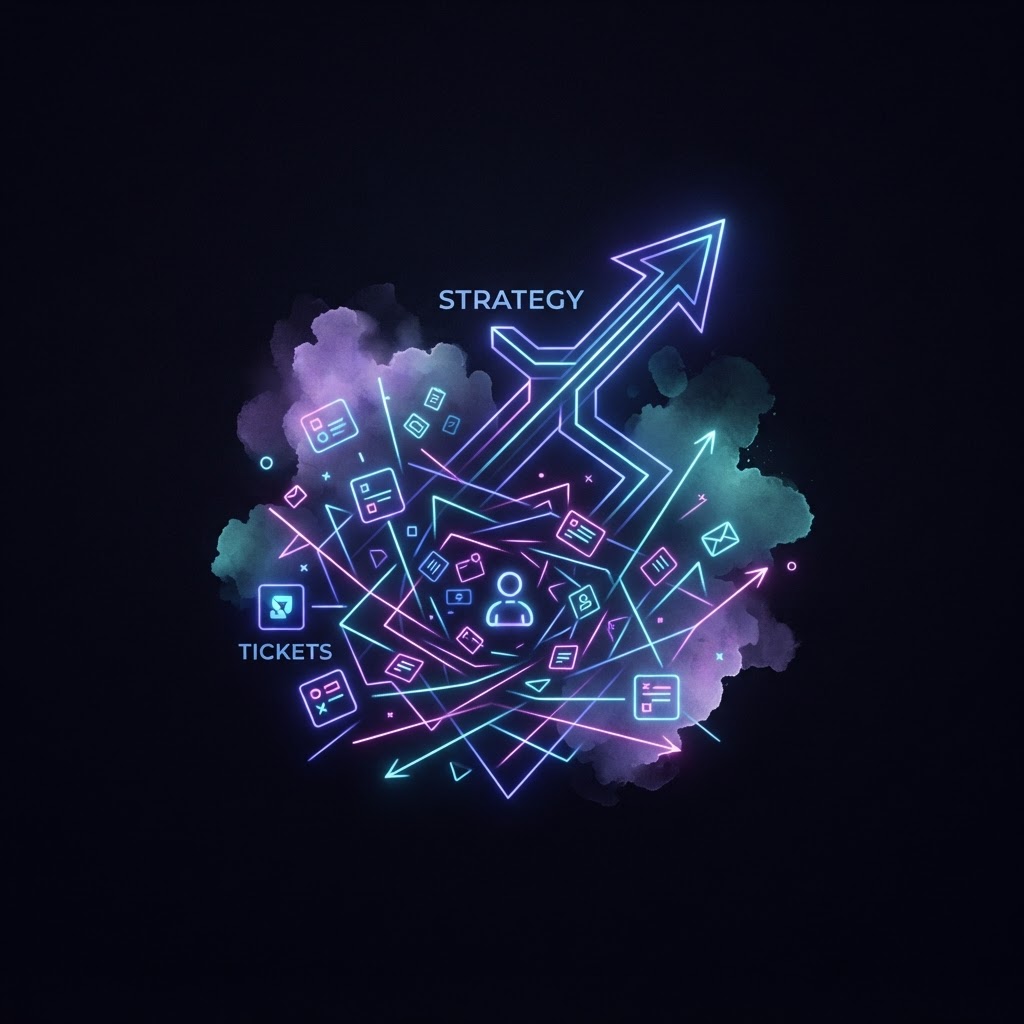
The Agentic Backlog: Why Your Jira Tickets Are Not a Strategy
The Trap of the Automated Ticket
I remember sitting in a boardroom, watching a leadership team celebrate a 20 percent increase in Jira ticket velocity. They were convinced they had reached peak efficiency. They had not.
They had simply accelerated the rate at which they were building the wrong things. If you read my earlier take, The Agentic Shift: Why Your Jira Backlog is Not a Strategy, you already know where this lands. We are currently witnessing a massive push to embed AI agents directly into the software development lifecycle, as seen in the latest [Atlassian](/https://www.
atlassian.com/blog/company-news/ai-sdlc) updates. It is tempting to view these agents as digital interns, ready to churn through your backlog.
But when you treat an agent as a replacement for a developer, you are ignoring the fundamental reality of strategic friction.
The Illusion of Velocity
Efficiency is a dangerous metric when it is decoupled from intent. When you deploy agents to handle planning, coding, and reviews, you are not just speeding up work. You are changing the nature of the work itself.
This is classic cognitive throughput territory. If your team is spending all their time managing the output of agents, you have not gained time. You have simply shifted your burden from creation to curation.
The real value of an agentic system is not in how many tickets it closes, but in how much it frees your senior talent to focus on the messy, human-centric problems that machines cannot touch.
Building for Resilience
- Move toward defining outcomes rather than tasks. Agents excel at execution, but they struggle with the nuance of business goals.
- Prioritize the integration of your knowledge graph. If your agents do not understand the context of your business, they are just hallucinating at scale.
- Build for human-in-the-loop governance. You need to know when to let the agent run and when to pull the emergency brake.
What this means for leaders
Your role is shifting from manager of people to architect of systems. You are no longer just assigning tasks. You are designing the environment in which agents and humans collaborate.
Move toward building a culture where your team feels empowered to challenge the agent's output. Encourage them to treat AI suggestions as hypotheses to be tested, not as gospel to be implemented. Your goal is to create a system that is robust enough to handle the speed of AI, but flexible enough to accommodate the wisdom of human experience.
My personal note
I have seen too many leaders get seduced by the promise of a fully automated pipeline. It is a mirage. The most successful organizations I work with are the ones that use AI to amplify their human talent, not replace it.
They use agents to handle the drudgery so their people can focus on the high-value, high-stakes decisions that actually move the needle. Do not get distracted by the shiny new tools. Focus on the outcomes you are trying to achieve, and build your systems to support those goals.
You are the architect of your organization's future. Build it with intention.
The Enterprise & Public Sector AI Integration Playbook
No spam. One email with the asset, then occasional Spark updates.